Defeating Autism: A Damaging Delusion by Michael Fitzpatrick
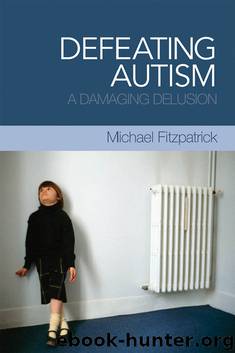
Author:Michael Fitzpatrick [Fitzpatrick, Michael]
Language: eng
Format: epub
Tags: Behavioral Sciences
Published: 2011-01-25T06:40:45.265000+00:00
9780203888391_4_006.qxd 03/09/2008 20:22 Page 76
6
Genes or toxins?
As yet, research in autism has failed to identify any major environmental factor that contributes to causation.
Patrick Bolton (Bolton 2001)
Autism is one of the most heritable complex disorders, with compelling evidence for genetic factors and little or no support for environmental influence.
Jeremy Veenstra-Vanderweele (Veenstra-Vanderweele 2004) Many in the advocacy community are thankful because, starting today, the government is finally going to make environmental research a priority, which will lead to better treatments and recovery. Because if autism is environmental, then it is treatable and preventable. It is no longer hopeless, nor lifelong. It is hopeful, with a possible cure.
Laura Bono (Bono 2007)
In terms of their understanding of the causes of autism, mainstream researchers and biomedical activists appear to occupy parallel universes.
Over the past 30 years, scientific study has focused on genetics and attempts to discover the neurobiological pathways leading from defective genes to the distinctive behavioural features of autism. Authorities – such as Patrick Bolton in the UK and Jeremy Veenstra-Vanderweele in the USA
– reckon that genetic factors account for 90 per cent of cases of autism, a rate higher than for most other genetically influenced conditions, whether in medicine (diabetes, coronary heart disease) or psychiatry (schizophrenia, bipolar affective disorder). Yet for anti-vaccine parent campaigners like Laura Bono, genetic research is a distraction of energy and a misdirection of resources from the quest to discover environmental causes of autism. As we have seen, the belief of the biomedical movement in the notion of an ‘autism epidemic’ is crucial to the elevation of environmental over genetic factors (as the activists say, ‘whoever heard of a genetic epidemic?’). Though the rise of genetic theories in the 1970s may have helped to relieve an earlier generation of parents of the burden of 9780203888391_4_006.qxd 03/09/2008 20:22 Page 77
Genes or toxins? 77
psychogenic ‘parent-blaming’ theories, for today’s biomedical parents genetic explanations imply not only an unwelcome degree of parental responsibility, but also fatalistic notions that autism is a constitutional, lifelong and immutable condition. Environmental theories by contrast, raise hopes of prevention, treatment, even cure.
The genetics-environment dialogue is fraught by confusion, starting from the ways in which these two terms are themselves understood. For many parents, ‘genetics’ means ‘something passed on in the family’, as they search the family tree for some explanation for their child’s condition.
It is true that some genetic disorders are transmitted by parents to their children and that individuals manifesting the genetic defect – of, for example, haemophilia or cystic fibrosis or sickle-cell anaemia – can be identified among relations near and far. Some parents will discover in their extended families other individuals on the autistic spectrum or manifesting features of the ‘broader autism phenotype’ (milder versions of the triad of autistic features). Other parents will not find affected individuals in their families.
This is because some genetic disorders are not inherited from parents or grandparents, but result from mutations taking place at the moment of formation of eggs and sperm or during fertilisation. Autism may be associated
Download
This site does not store any files on its server. We only index and link to content provided by other sites. Please contact the content providers to delete copyright contents if any and email us, we'll remove relevant links or contents immediately.
Unwinding Anxiety by Judson Brewer(73189)
The Art of Coaching by Elena Aguilar(53415)
The Fast Metabolism Diet Cookbook by Haylie Pomroy(21181)
Rewire Your Anxious Brain by Catherine M. Pittman(18709)
Healthy Aging For Dummies by Brent Agin & Sharon Perkins RN(17069)
Talking to Strangers by Malcolm Gladwell(13438)
The Art of Thinking Clearly by Rolf Dobelli(10597)
Mindhunter: Inside the FBI's Elite Serial Crime Unit by John E. Douglas & Mark Olshaker(9418)
Crazy Rich Asians by Kevin Kwan(9345)
The Compound Effect by Darren Hardy(9052)
Tools of Titans by Timothy Ferriss(8490)
Periodization Training for Sports by Tudor Bompa(8329)
Becoming Supernatural by Dr. Joe Dispenza(8277)
Wonder by R. J. Palacio(8165)
Bodyweight Strength Training by Jay Cardiello(7968)
Crystal Healing for Women by Mariah K. Lyons(7965)
Change Your Questions, Change Your Life by Marilee Adams(7847)
Nudge - Improving Decisions about Health, Wealth, and Happiness by Thaler Sunstein(7758)
Therapeutic Modalities for Musculoskeletal Injuries, 4E by Craig R. Denegar & Ethan Saliba & Susan Saliba(7744)
